Showing posts with label feminism. Show all posts

Saturday, 1 March 2014

3rd fabric piece: slogan underwear

My third piece of fabric work is influenced by the feminist artists/textile artists I have researched so far. The set of 3 pairs of women's underwear is a comment on existing mass-produced, mass-marketed clothing, and the message it gives out to not only the women and girls who buy it, but any man who sees it.

Initially I sampled different colours and texts:


I decided to make the text more "stereotypically feminine" rather than using "masculine" block letters:


In contrast to the mass-produced underwear seen in shops, these are handwritten messages on ordinary, plain garments, reflecting the need to "de-sexualise" such clothing, make it less provocative, less mass-marketed, and less available to impressionable young people.

Monday, 24 February 2014

"Wearable fabric art"

Whilst some artists like Miller and Morris use fabric in an implicit, suggestive way, it is often used to convey a far more literal message. Commonly found in shops worldwide, slogan clothing was made popular by Katharine Hamnett, and is now mass produced all over the world.

Katharine Hamnett's slogan t shirts


However this type of clothing, which began by conveying a positive political/social message, now often leans towards jokey or even crude slogans:


Slogan underwear like this is frequently seen in shops aimed at young people, leading them to think that these messages, which often promote promiscuity or sexualise young girls, are acceptable. 

Some feminist artists have already used underwear in their work to symbolise various issues:

Sarah Lucas, "Chicken Knickers"


Feminist slogan underwear, by Sami Cronk


Common themes in this kind of work include reinforcing the idea that women shouldn't have to wear nice underwear for men, and that tacky slogan clothing like that seen above does not give an accurate representation of women. It is also another reference to the fact that making clothes, sewing and embroidery are all seen as stereotypically "female" skills.


Wednesday, 19 February 2014

2nd fabric piece

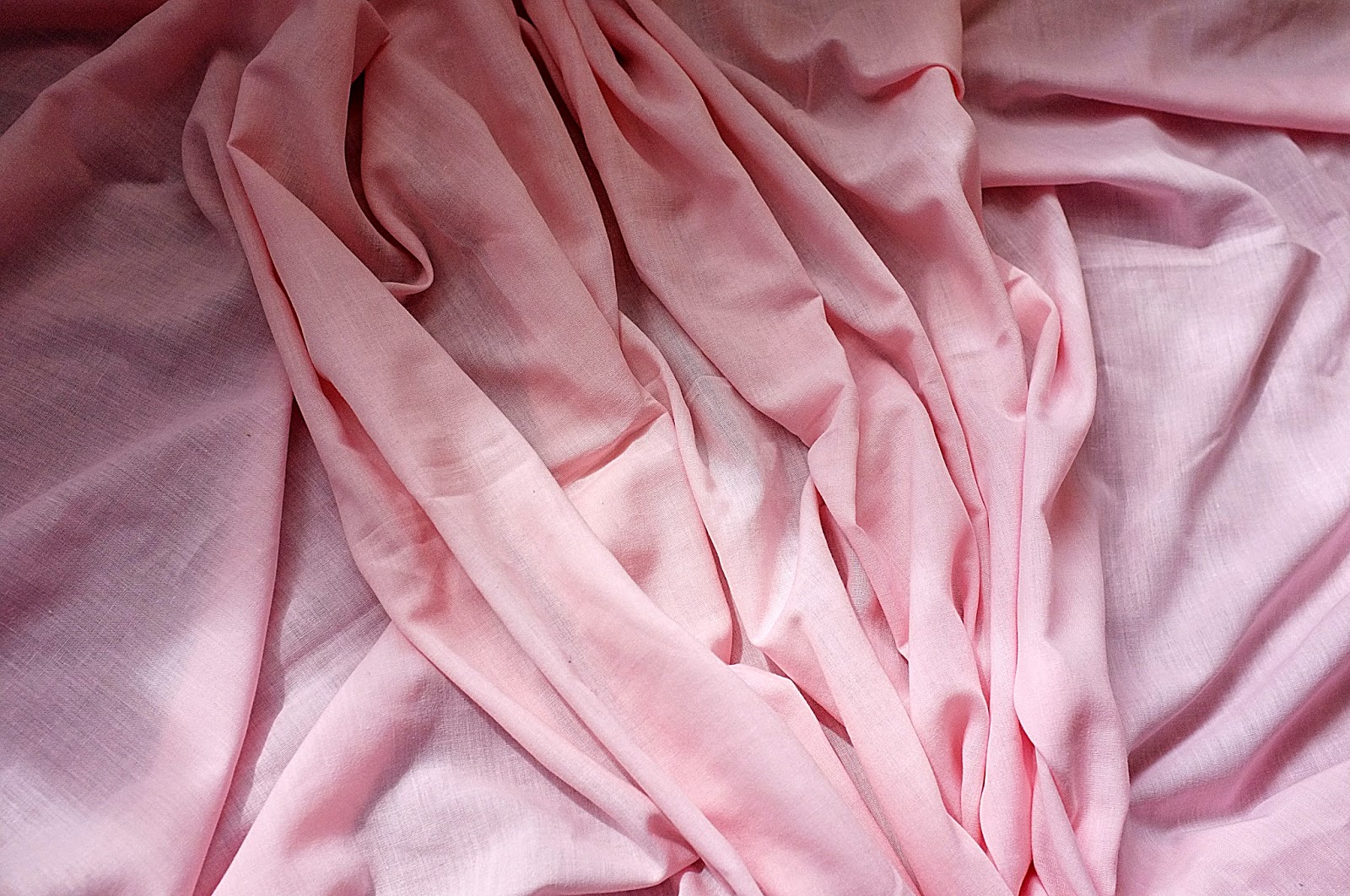
My last fabric pieces were a subtle comment on women's position in society, and the way they can be used. Continuing to explore this idea in my next piece, I have once again used pink fabric as the stereotypical symbol of femininity, but I have used a bed sheet to create more connotations of "woman's work" (i.e. making beds, housework etc).


The folds and creases are also suggestive of female anatomy, as is the colour pink...

"According to surveys in Europe and the United States, pink, especially when combined with white or pale blue, is the colour most commonly associated with femininity, sensitivity, tenderness, childhood, and the romantic. However, when combined with violet or black, it is associated with eroticism and seduction"


Wednesday, 29 January 2014

Emily Miller - fabric work

Feminist art works are often made from particularly tactile materials (often contrasting ones ~ e.g. silk and pins) which highlight the contrast between men and women, or show that despite women's bodies are soft, they can be strong too.


Emily Miller, "X Chromosomes"


Emily Miller created this work from baby pink faux fur and steel, two contrasting materials - one stereotypically seen as "feminine" and the other "masculine". Named after the the two gender-determining chromosomes that decide whether a baby is a girl, the work is visually striking in terms of size, shape and materials used. The colour and tactile fur fabric suggests softness and delicacy, traits that are stereotypically associated with women, but the size and bold shapes of the piece imply strength and power: stereotypical male traits.

Monday, 27 January 2014

Feminist textile art

Several contemporary feminist artists use specific textiles and fabrics in their work, perhaps as a comment on stereotypically female activities like washing, sewing, dressmaking etc.


1) Julia Triston

Julia creates "knicker bunting", which has been used to launch the University of York's "Carnival of Feminist Cultural Activism".


2) Lin Tianmiao
Lin has made "badge" installations which show all the derogatory names a woman can be called.


3) Judy Chicago

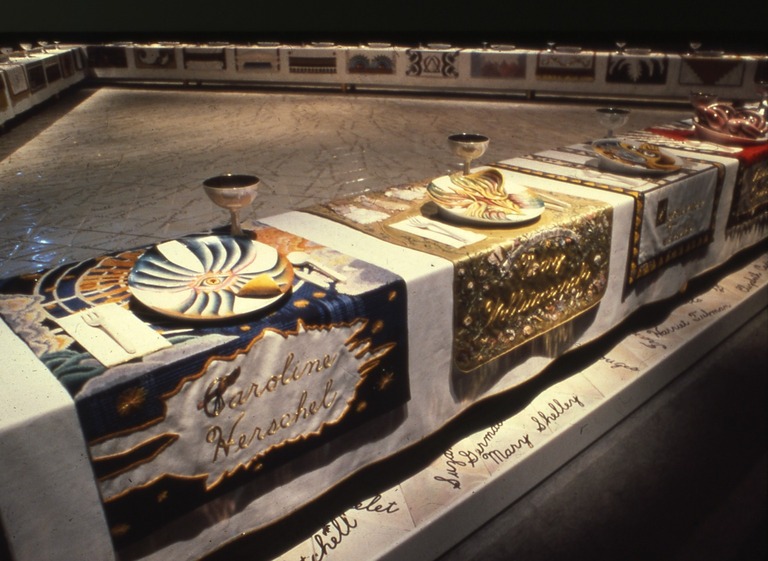
Arguably Judy's most famous work, "The Dinner Party" is an installation which includes place settings (carrying connotations with "female jobs" like cooking and sewing) for 39 mythical and historical famous women, with 999 more named on the floor tiles. Judy's goal for this work was to "end the ongoing cycle of omission in which women were written out of the historical record". Butterfly or flower-like sculptures are used to represent vulvas, and the piece celebrates traditional female accomplishments like textile arts, which have been framed as craft or "domestic art", as opposed to the more culturally-valued, male-dominated fine arts.


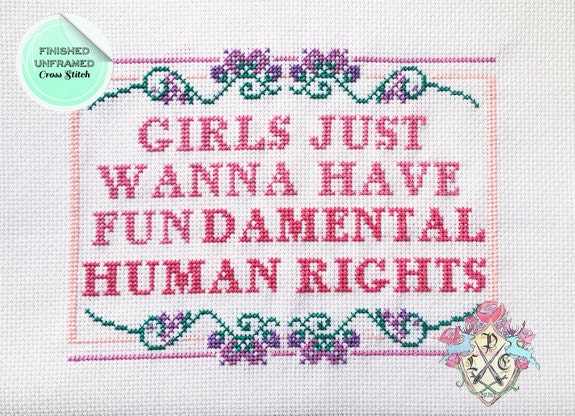
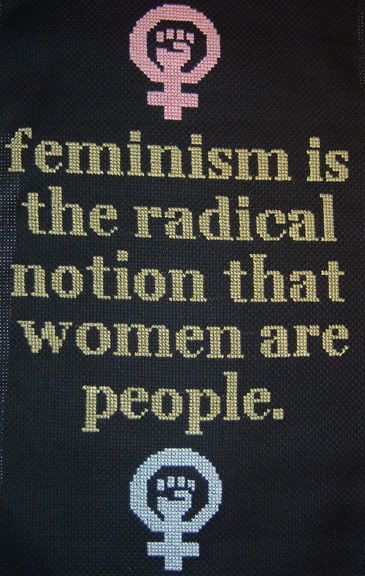
4) Feminist cross stitch

Perhaps as a "nod" to artists like Chicago, many feminists in today's society are creating "traditionally female" art like cross stitching, but with an obvious feminist overtone:


5) Naiza Khan


In stark contrast to the soft fabrics used by some other feminist artists, Naiza uses metal and nails to create items of clothing historically used to restrain or hinder women:


Armour skirt


Armour corset


Thursday, 23 January 2014

Contemporary feminist art: an overview

Historically, artists (predominantly male painters) used the female body as a muse, something to serve as inspiration for painting "the perfect woman". In contrast, contemporary feminist arists (both male and female) now use a variety of media and subject matter to explore the idea of equality and feminism.


Poster by the Guerrilla Girls.


"The Dinner Party", sculptural work by Judy Chicago.

Typographic/photographic work by Barbara Kruger.


The wide range of materials used in modern feminist art allow the artists to explore a variety of subtopics within the broad subject that is feminism and equality. Since the 1960s and 1970s, the feminist art movement has expanded continuously, and there are currently many major artists who are not only female themselves, but who make art about feminism and female equality.

Monday, 20 January 2014

Project intro & initial ideas

The idea of "femininity vs. masculinity" is one that I am exploring across several modules at university, and as part of my research I have been looking at feminist art, the ways that women are portrayed in art and in society, and how we use clothing and makeup to make a statement about ourselves or to enhance or disguise our identity. I am going to base my SP&CA Project 2 in this area, particularly because feminism, women's equality, rape culture etc. are still massive topics in today's news and politics.

As with previous projects, I want to use a variety of media to explore my ideas, including digital/photographic work, sculptural work and drawing/illustration. Using a wider range of media has allowed me to explore topics in more detail than if I were to focus on just one medium.